
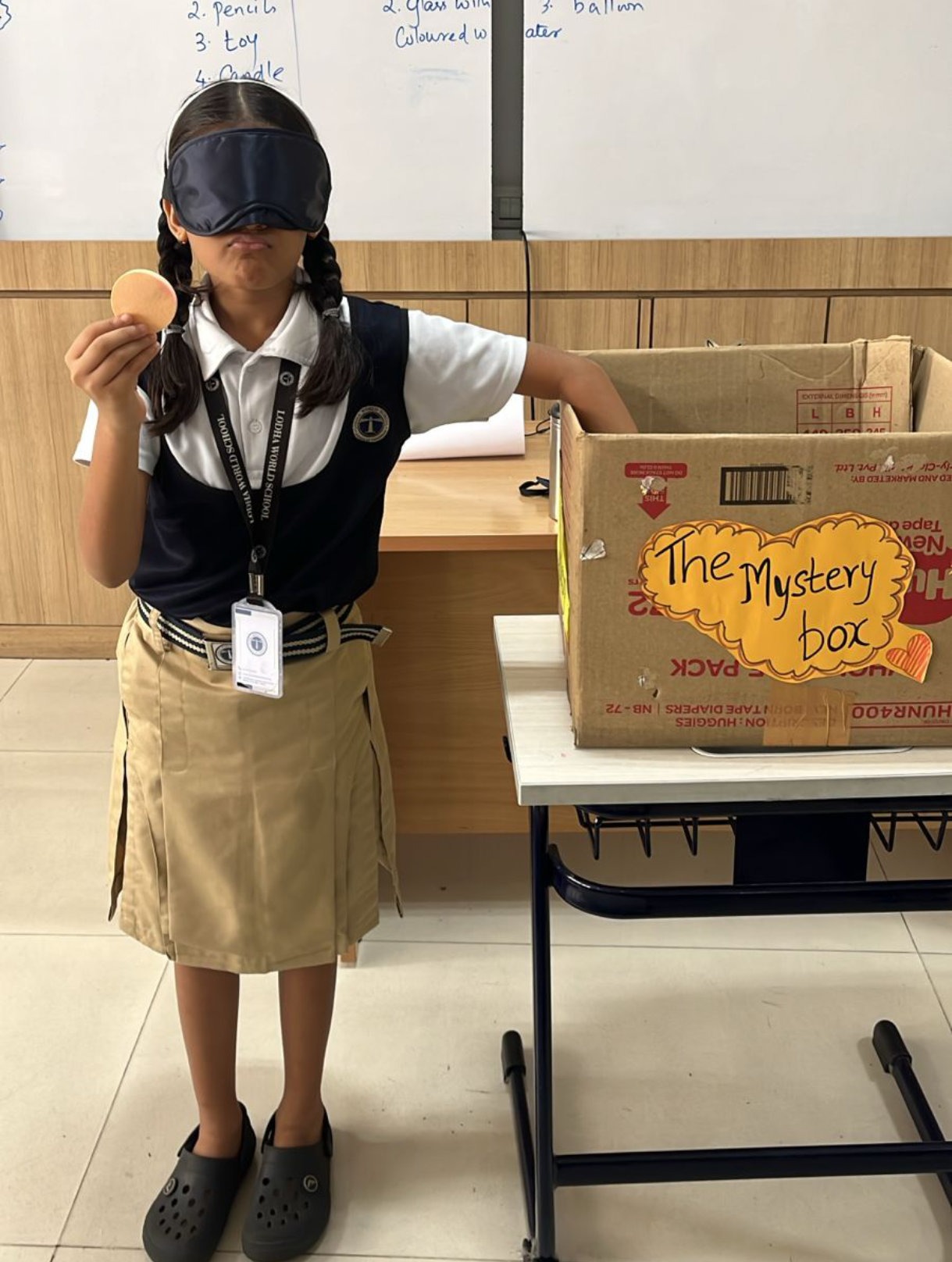
A few weeks ago I spent 40 minutes at the back of a third-grade EVS classroom, watching a lesson on plants. I wasn't there to teach. I was there to observe. And somewhere between a question about seeds and a question about growth spurts, the children ended up teaching me something instead.
One child wanted to know if the seed we plant literally travels up the stem to go live inside the new fruit, a tiny botanical commuter making its way home. Another, with the instincts of a sharp young consumer, wanted to know why fruits bother having seeds at all, when seedless ones are obviously tastier. And a third, with a logic so clean it should embarrass most adults, asked: if eating is what makes us grow, why do we stop getting taller later in life even though we never stop eating?
None of these questions were "wrong," and none of them were really about botany or biology at all. They were about a mind trying to build a model of the world: no shortcuts, no assumptions, no textbook definitions accepted on faith.
I walked out of that school with a lesson circling in my head, and it wasn't about seeds. It was a question I turned back on myself: when was the last time I stopped to watch something, or wonder about something, purely for the sake of it? Not to solve it, not to explain it to someone, not to turn it into content. Just to notice it?
I couldn't immediately answer. And that, I think, is the real story here.
It's tempting to say adults "lose" their sense of wonder as they age, as if it simply wears out like an old battery. I don't think that's quite right. I think we trade it: deliberately, gradually, and usually for something that feels more useful in the moment.
We trade wonder for efficiency. An orange stops being an intricate, seed-bearing survival strategy evolved over millions of years, and becomes "breakfast." A tree stops being a slow, patient miracle of engineering, and becomes "landscaping." A commute becomes a task to be optimized, not a stretch of the world worth looking at.
This isn't laziness. It's an adaptation. Adults are, quite literally, busy managing lives: jobs, families, deadlines, decisions. Treating the orange as "just breakfast" is what lets us get out the door on time.
"Is curiosity expensive in a currency most of us feel we don't have enough of? Is that currency attention?"
But there's a cost to that trade that we rarely account for. When we stop asking "why" or "how else could this work," we don't just lose a childish habit, we lose our best tool for actually understanding anything new. Efficiency is wonderful for repeating what we already know, not so much for discovering what we don't.
So, what is it that third-graders still have that we've packed away?
Watching that classroom, what struck me wasn't that the children were smarter than the average adult in the room—they weren't, in any conventional sense. What they had, that most adults have quietly packed away, was permission. Permission to not know. Permission to ask a question that might sound obvious, or strange, or even a little silly. Permission to look at something completely mundane—a fruit, a stem, their own height—and treat it as genuinely mysterious. Or as we say at S2S, have they stopped exercising their special right “to not know everything”?
I feel, often, adults tend to operate under an unspoken rule: questions should demonstrate that you already understand most of the answer. Ask something too basic, and you risk looking uninformed. So we quietly stop asking, not because we've run out of questions, but because we've started managing how our questions make us look.
Third-graders haven't learned that rule yet. To them, "why do fruits have seeds" is not a naive question—it's a completely legitimate design query about a world they're still mapping out. That is, in fact, exactly how scientific and creative thinking works at any age: you have to be willing to ask the "obvious" question before you can get to the interesting answer.
Why does this matter more in classrooms than anywhere else?
This is where the stakes get higher, especially for those of us who work in and around education. A classroom is one of the few places where a child's instinct to observe and wonder can either be nurtured into a lifelong habit, or gently trained out of them.
It happens in small, well-intentioned ways. A curriculum that has to "cover" a syllabus by a certain date doesn't always leave room for a five-minute tangent about how tall a person can actually grow. A classroom management style that rewards quick, correct answers can inadvertently discourage the meandering, uncertain, "wait, but why" kind of question, because it's slower, and because it doesn't always resolve neatly. Even well-meaning teachers, under real time pressure, can end up subtly signalling that questions should stay inside the boundaries of the lesson plan.
None of this is anyone's fault. It's a structural pressure that most education systems create by default: cover the content, hit the outcomes, move to the next topic. But if we're not careful, that pressure can slowly convert naturally curious five- and eight-year-olds into efficient answer-producers by the time they're teenagers: students who've learned that the fastest way through school is to stop asking the questions that don't have a clean answer in the back of the book.
The irony is that the questions those third-graders asked—about seed transport, about the "design" of fruit, about the limits of growth—are exactly the kind of questions that, followed a little further, lead to genuine understanding of botany, biology, and even the nature of scientific inquiry itself. Curiosity isn't a detour from learning. It usually is the learning, just not yet dressed up in the vocabulary we are used to.
Protecting this instinct, in classrooms and in ourselves, isn't about romanticising childhood or pretending adults should behave like eight-year-olds. It's about deliberately rebuilding a habit that gets trained out of us by convenience.
A few things seem to help, both in the classroom and outside it:
- Let "why/how" be a valid stopping point, not a detour. In a classroom, this might mean building in five unstructured minutes for the "off-topic" questions a lesson provokes, instead of treating them as a distraction from the syllabus. Some of the richest learning happens exactly there.
- Students (and adults) calibrate their curiosity based on what gets acknowledged. A classroom, or a team, or a household, that visibly values a good question, even an unresolved one, keeps that muscle alive far longer than one that only celebrates correct answers.
- Noticing without a certain agenda, is the adult version of the third-grader's superpower. Pick one mundane thing a day: the way steam curls off a cup, the sound your front door makes, why a queue moves the way it does, and actually look at it for thirty seconds before moving on. You're not trying to solve anything. You're just re-training the habit of looking.
- Try asking a question you're not going to look up. Let it sit unanswered for a day. Modern life makes every question instantly Google-able, which quietly kills the pleasure of just wondering. Sometimes the value is in carrying the question around, not resolving it in four seconds.
- Kids absorb curiosity as a behaviour, not a lecture. A teacher or parent saying "huh, I actually don't know why that happens, let's find out together" does more for a child's relationship with wonder than any amount of encouragement to "ask questions."
The question I'm still sitting with is:
I still don't have a clean answer to the question those third-graders left me with—not the one about seeds or fruit, but the one I asked myself on the walk out of that school: when was the last time I stopped to watch or wonder about something purely for the sake of it, with no outcome in mind?
If I'm honest, I have a small example, and it's almost embarrassingly ordinary. A friend and I were debating, late one night, whether to have coffee at all. Too late, too much caffeine, bad idea. We randomly came up with the idea of having "decaf" like it solves everything, and that one word quietly derailed the rest of our chat. How do they even get the caffeine out? Is that a chemical process, a physical one, something involving water, or heat, or pressure? And however they do it, how do they manage to pull out the caffeine without also pulling out everything that makes coffee taste like coffee? We had no idea. We spent the next twenty minutes constructing increasingly elaborate, increasingly wrong theories, like two people trying to reverse-engineer a magic trick. We never got an answer, and neither of us looked it up. We just enjoyed not knowing, for once. Except, one good tangent about decaf doesn't quite settle the larger question. It still feels like a lucky exception, not proof that the habit's around, to let me reconnect to this joy whenever I want!
I feel the question of how often I get to do this, that's the right kind of question to sit with, unresolved, for a while.
When was the last time you channelled your inner third-grader, and just stopped to observe something, purely for the fun of it?
Feel free to share thoughts/anecdotes with us, we’d be elated to hear responses.