Ponderbooks and Pondersheets: pedagogy and assessment tool
Inquiry workbooks that put the wondering before the concept, for grade school in Maths and Science, aligned to the textbook your school already uses.
What is a Ponderbook?
Inquiry is an inquisitive state of mind. Children are naturally inquisitive, and the role of educators is to tap into this inquisitiveness so that children construct their own knowledge and take ownership of it. Our approach is discovery-based and inquiry-driven, and at the same time curriculum-oriented: the inquiry serves the chapter the class is about to study.
A Ponderbook is a workbook of open-ended explorations that goes with the textbook your school already uses. Before the textbook chapter, children meet a situation, question it, argue about it and try things; then the textbook definition arrives as the name for what they have already seen. Pondersheets do the same job as loose sheets, one open-ended sheet with each curriculum-aligned module, for subjects where we do not publish a book. Because a Ponderbook sits alongside a textbook, the same Ponderbook works across boards.
Many schools that resonate with inquiry are committed to the textbook they use: board alignment, parent expectations, teacher familiarity and the cost of switching all count. Ponderbooks were made for exactly this.
Why Ponderbooks?
A concept a child has wondered about, tested and discussed is one they own, and can use when it turns up somewhere unfamiliar. The Ponderbook gives every chapter that first step of observing, questioning and tinkering, in a joyfully challenging and mistake-friendly way, within the school's own syllabus and timetable.
It is also an assessment tool. Our aim is to shift the focus from evaluating knowledge to evaluating skills, and the open-ended questions make a Ponderbook the easiest place for a teacher to see where their own class stands, chapter by chapter, and to adjust the teaching before the test.
How it works
Before the textbook chapter
Children work through the Ponderbook explorations for the chapter. The order matters: a Ponderbook chapter runs before the textbook chapter. Run after it, the same pages become revision.
The textbook chapter
The definition in the school's own textbook now arrives as the name for something the class has already seen and discussed. The teacher notes carry what children usually say at each point and the misconceptions each exploration is designed to surface.
Hands on, with the kit
The matching experiential learning kit, 25 to 30 explorations per grade, gives every child the materials for the explorations in class and at home.
Assessment
The open-ended Ponderbook and Pondersheet questions show what each child understands and how they reason, so the teacher can see the gaps in their own class.
What your school receives
Seed2Sapling provides
- Ponderbooks for grade school, Maths and Science, aligned to NCERT and to ICSE textbooks
- Pondersheets for other subject areas
- Teacher notes and the misconceptions each exploration is designed to surface
- The matching experiential learning kit, 25 to 30 explorations per grade
- Nurture app access: lesson planning, resources and the competency-based question bank
- Teacher orientation before the year starts
The school provides
- The textbook your school already uses; the Ponderbook is aligned to it
- Teachers' time for the orientation before the year starts
- The pedagogical mentoring alongside: Ponderbooks and kits are taken as part of Learn2Learn, so the workbook is carried by the teaching and does not become extra homework
Putting it in place
This is the lightest entry point we have, and the most common first step for a school that is keeping its curriculum. A school can take one subject in one grade band and stop there.
Books and kits are taken as part of Learn2Learn, with the pedagogy behind them. Schools that later want the whole chapter built this way move to the Anubhooti textbooks.
From the classroom
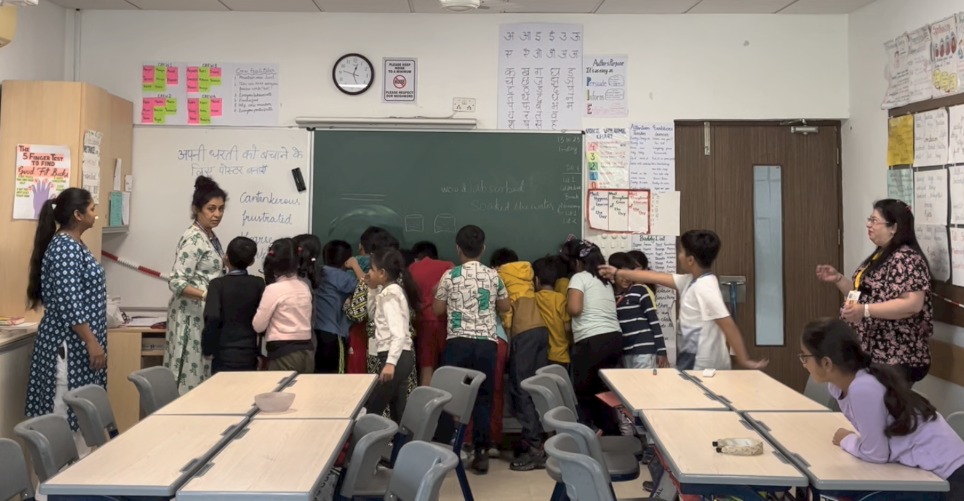
"First time they are learning integers through the Ponderbook activities, and they can easily understand the concept. I didn't expect this topic to be easy to teach, but with the activities they are giving more answers on their own."
Let's talk about what your school needs
Partner with usAlso worth looking at: Experiential learning textbooks · Exploratory materials and kits · Assessment strategies