Exploratory materials and kits
25 to 30 hands-on explorations per grade, built from open-ended materials that can be used more than one way, and matched chapter by chapter to what is being taught.
What are the kits?
We believe the materials of inquiry can be simple and everyday, and that they belong in every child's own hands. Learning is most effective when children construct their own knowledge through the tools of inquiry: concrete and abstraction go hand in hand.
Our exploratory kits are science and maths kits for each student, made of simple, open-ended, everyday materials that children can use in more than one way, at school and at home, compatible across chapters, together with the raw materials teachers need to teach certain topics. Each grade's kit carries enough material for 25 to 30 hands-on explorations, matched chapter by chapter to the book and the lesson plan.
Why open-ended materials?
When materials can only be used one way, every child arrives at the same result and there is little left to discover. Discovery happens when the materials are open enough to be wrong with, and the classroom is mistake-friendly enough to let children find out for themselves.
Open-ended materials also let children observe, question, tinker and discover in their own way, and take the exploration home. The National Education Policy asks for learning that is experiential, hands-on and discovery-oriented; the kit is how a chapter becomes that in a regular classroom.
How it works
Every exploration is designed on the same stance: hearts-on, heads-on and hands-on, happening together.
Hearts-on
An exploration begins with something children have noticed in daily life, or a real problem they want to solve, so that they care about the topic before the material comes out.
Heads-on
Children reason about the open questions the material raises, predicting what will happen and working out why.
Hands-on
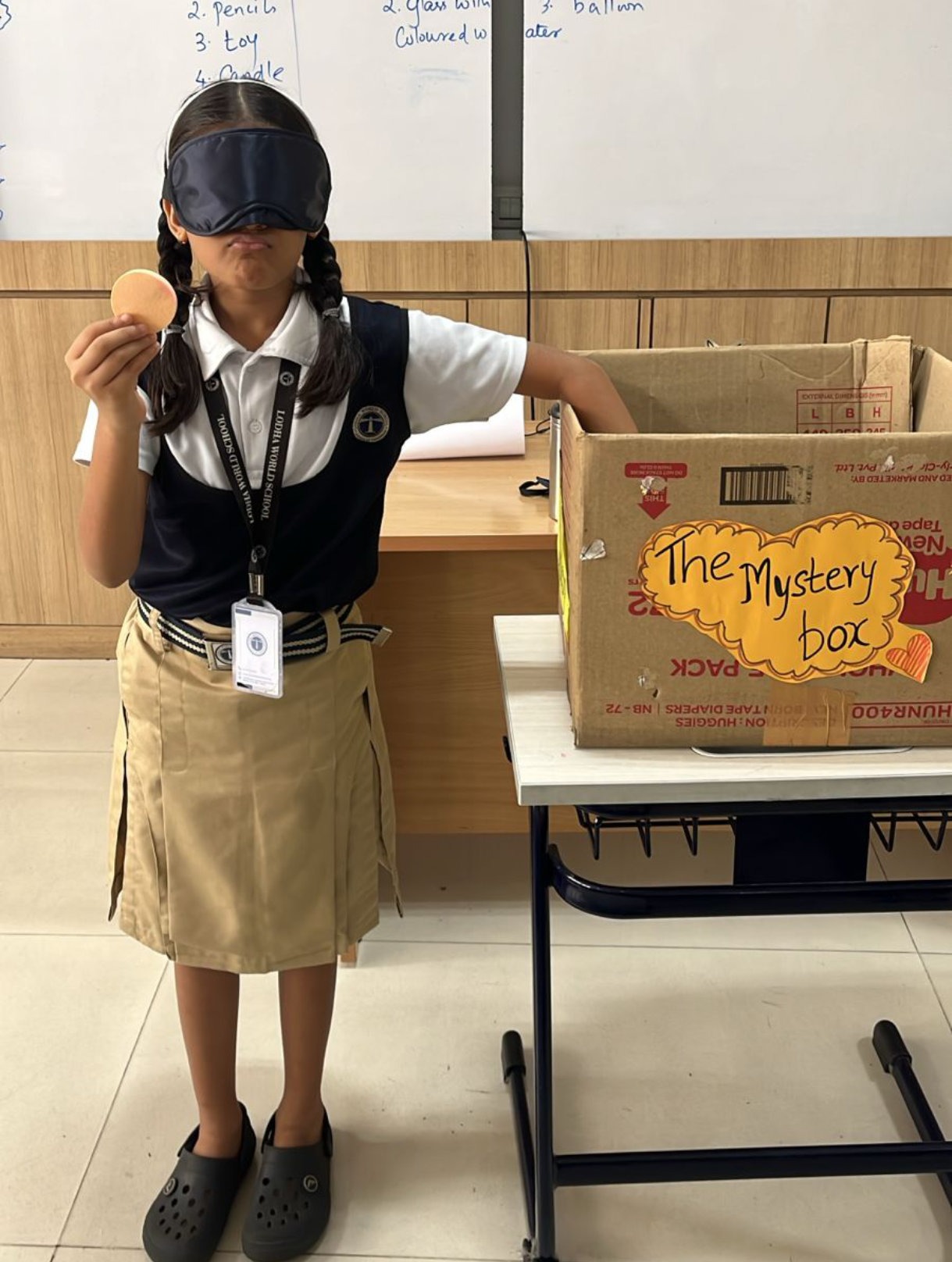
Children take part in exploratory hands-on activities with the kit, in a group or individually.
The same set turns up across chapters in different roles, so children get familiar enough with the material to stop being distracted by it and start thinking with it.
The kit works with Anubhooti, with Ponderbooks, or with the textbooks your school already uses.
What your school receives
Seed2Sapling provides
- Enough material for 25 to 30 hands-on explorations per grade, across Maths and Science
- A kit for each student, made of simple, open-ended, everyday materials children can use in more than one way, at school and at home, compatible across chapters
- Raw materials for teachers to teach certain topics
- A material list and a per-chapter activity checklist for each subject
- Activity lesson plans matched to the chapters
- Works with Anubhooti, with Ponderbooks, or with the textbooks your school already uses
- Teacher orientation on the materials before the year starts
The school provides
- Teachers who take the materials into the classroom before each chapter begins, so the kit is in children's hands when the lesson needs it
- A place in each classroom where the materials stay within reach, and time in the timetable for the explorations
- The books alongside: kits are usually taken with Anubhooti or Ponderbooks, as a combined book-and-kit set per child
Putting it in place
Kits are taken per student per year, as part of Learn2Learn, usually with the books as a combined book-and-kit set per child.
Every activity in the kit is tied to a chapter of the syllabus. A school that has a Math Lab or a Tinker Den can run those chapter activities in the space, so the room is used as part of regular teaching and not only for occasional visits.
From the classroom
"When we first gave the task of making a vehicle, we expected mostly cars. But the children surprised us with parachutes, boats, rafts and even aeroplanes. It was exciting to see how they thought beyond what we had imagined."
Let's talk about what your school needs
Partner with usAlso worth looking at: Experiential learning textbooks · Ponderbook: pedagogy and assessment tool · Math Lab